Kennedys Brings ERG Leaders Together on Building Networks That Last
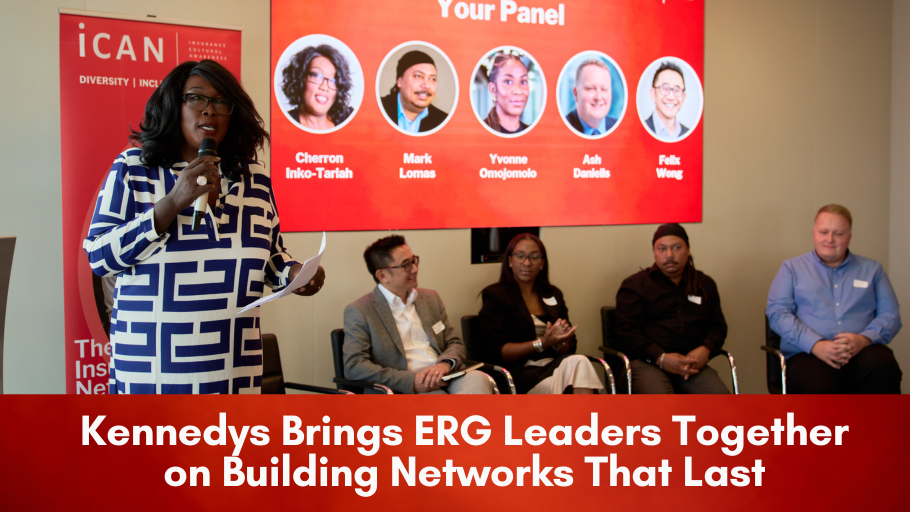
On 23 July, Kennedys hosted a cross-industry panel bringing together senior culture and ERG leaders from across legal and insurance at 20 Fenchurch St to talk honestly about how employee networks earn lasting support rather than surface-level goodwill.
Moderated by Cherron Inko-Tariah MBE, Founder and CEO of The Power of Staff Networks, Author, Consultant, and Coach, the session combined structured panel input with open discussion, drawing on the experience of Felix Wong, iCAN Committee Member and co-founder of a multicultural network at Allianz; Yvonne Omojomolo, who oversees eleven employee networks at News UK; Mark Lomas, Head of Culture, Talent and Communities at Lloyd's; and Ash Daniells, Legal Director and co-chair of Kennedys LGBT+ network.
ERGs earn sustained investment when they're tied to measurable business outcomes, not treated as a stand-alone diversity exercise.
When political or global events hit close to home, targeted internal support does better than a public statement.
Sustainable networks need structure: defined sponsor roles, rotation, pooled budgets, and formal recognition for the people who run them
Making the business case
Mark Lomas described how Lloyd's has approached governance across its networks, anchoring different groups to a shared set of values rather than letting them operate in isolation.
“At Lloyd's, we have several networks operating at different levels with different connections; but one thing that's been really strong is the connection to values. Finding deliverables and being deliberately intersectional gave us a wider audience and more support, and that became a structural incentive in itself.” Mark Lomas, Lloyd's
Ash Daniells brought a similarly practical lens, pointing to how much value sits in simply having people in place who can support colleagues directly.
“Having people on the team who can support individuals is invaluable. No one expects us to have all the answers; they just want us to be there.” Ash Daniells, Kennedys
Support, not statements, during global events
A recurring theme was how ERGs should show up when geopolitical news dominates the headlines. Felix Wong was clear that the responsibility for supporting staff shouldn't sit entirely with employee networks.
“Staff want to feel heard and understood in situations like political news. ERGs are there to support; but it's not entirely their responsibility.” Felix Wong, Allianz
Mark Lomas added that clarity of expectation is what makes engagement possible in the first place, for network members and allies alike.
“Being clear about the expectation sets the framework that makes it easy to engage; and making sure allies can connect with diverse groups, celebrating progress and cultural moments, matters just as much.” Mark Lomas, Lloyd's
Building genuine allyship
Yvonne Omojomolo spoke to the practical challenges every network face: getting people to engage and getting the wider business behind them.
“Getting people engaged, and getting the business involved, comes down to meeting allies where they are, through town halls, safe space sessions and targeted communication.” Yvonne Omojomolo, News UK
Ash Daniells returned to the theme, noting that allyship depends on people feeling safe enough to get involved without fear of getting it wrong.
“You have to let people feel comfortable, rather than alienating them for worrying they might say the wrong thing.” Ash Daniells, Kennedys
The business case, in numbers
The panel's central argument, that ERGs need to be judged on business outcomes, not just activity, is increasingly backed by data. Teleskope's 2025 Fortune 500 ERG Benchmark Report found that 57% of companies say their ERGs have directly influenced innovation, and separate 2025 benchmarking data reported by Absorb LMS found that new hires are two and a half times more likely to stay when they join an ERG within their first 90 days.
Within the Lloyd's market specifically, where two of the panel's speakers work, the 2025 Market Policies & Practices return showed ethnic diversity in the market workforce rising to 14%, with ethnically diverse leadership up three percentage points to 12%, and 22% of new hires coming from an ethnically diverse background. It's exactly the kind of structural, governance-led progress Mark Lomas described, built over successive years of the same annual return, not a single campaign.
If you're running an ERG: three things worth trying this quarter
Most of what the panel described isn't hard to start; it's just easy to keep putting off. To help, here are three places you could begin:
Write your sponsor's role down. Not a job title, a short document covering what they're expected to do, how often you'll meet, and what decisions they can influence. If that document doesn't exist yet, that's usually the first sign a network is running on goodwill rather than structure.
Pair up with one other network for one activity. You don't need a fully intersectional programme to start. Start with one joint session this year, with a shared budget line, is enough to test whether it earns the wider audience Lloyd's found.
Decide your response to global events before you need it. Agree in advance who staff can go to, what a safe space session looks like, and where your network's responsibility ends, and HR or leadership begins. Working that out mid-crisis is where burnout and mixed messaging both start.
Closing thoughts
operate: less about volume of events, more about deliberate structure, governance, sponsorship, pooled budgets, and honest boundaries around what a network can and can't be responsible for. As the panel made clear, none of that happens by accident. It takes clarity of expectation, sustained sponsorship, and networks willing to be judged on outcomes rather than intentions.
Thank you to Kennedys for hosting, and to Felix, Yvonne, Mark and Ash for their candour.
Follow iCAN on LinkedIn to stay up to date with future events and get in touch with the team if you would like to know more about the network and its initiatives.
About iCAN
The Insurance Cultural Awareness Network (iCAN) is a leading organisation committed to promoting diversity and inclusion in the insurance sector. Established in 2017, iCAN has been instrumental in spotlighting cultural awareness, fostering talent, and championing diversity within the industry.