Early-Career Professionals Attend Ryan Specialty & iCAN Careers Evening
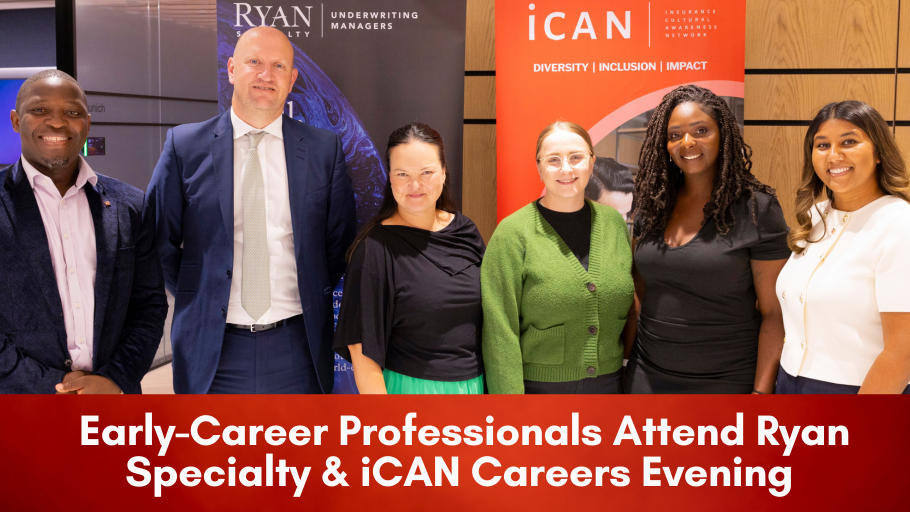
Ryan Specialty and iCAN recently brought together early-career professionals from across the insurance market for an evening built around three things: real career stories, practical development advice, and the skills needed to network with confidence.
The evening marked the first year of Ryan Specialty's internship programme, with interns joining alongside other early-career attendees from across the industry.
Here's what attendees took away.
There's no single route into insurance
The career stories shared on the night came from very different starting points: an internship found through the iCAN jobs board, a graduate scheme leading into underwriting, a first job found through a newspaper advert that eventually led into insurance recruitment. Between them, nearly five decades of market experience.
What stood out wasn't the differences, though. It was the common thread. However people got into the industry, they all pointed to the same thing as the key to progressing people and relationships. Insurance is often described as a technical industry, but the ability to build a genuine network can matter just as much as technical knowledge.
Careers rarely move in a straight line
A recurring message was that insurance careers are rarely predictable. Moves between companies, functions and classes of business are common, and so are the curveballs, acquisitions and organisational change that can reshape a career path without warning.
The advice was to see this as an opportunity rather than a setback. Insurance is a genuinely global industry, with careers being built in markets from the US and UAE to Australia and Singapore, and in emerging areas like cyber, AI and renewable energy. Early on, it's worth understanding the industry broadly, learning what underwriting, broking, claims, actuarial and data roles involve, before narrowing in on what interests you most.
You don't need every skill before you say yes
One of the most practical pieces of advice was about timing: don't wait until you feel completely ready. Moving into an unfamiliar underwriting class, for example, can feel daunting, but the technical detail can be learned. What matters more in the moment is recognising the transferable skills you already have: analysing information, communicating with brokers, understanding risk, building relationships.
For early-career professionals, the takeaway is simple. When an opportunity doesn't perfectly match your existing experience, look at the wider skills you bring rather than ruling yourself out.
Advice worth carrying forward
A few pieces of advice came up repeatedly through the evening:
Say yes to opportunities, even the intimidating ones, and work out how to deliver once you're in. Stay curious about your own role and the people and functions around you, because curiosity builds both knowledge and relationships. Take feedback seriously, especially the constructive kind, since it's often where the biggest opportunities to improve are found. Build your network early, since relationships formed during internships and early roles tend to become more valuable as your career progresses. And start professional qualifications early, while you have the time and momentum to study, rather than leaving them until responsibilities pile up.
Making the most of an internship: the PIE framework
The evening also covered practical guidance for getting the most out of an internship, built around three areas.
Performance. Delivering good work is non-negotiable: complete tasks accurately, meet deadlines and show that you can be trusted with responsibility.
Image. Think about the professional reputation you're building through how you communicate and work with others.
Exposure. Good work needs visibility. That doesn't mean bragging, but it does mean making sure managers and colleagues understand what you've contributed.
It's worth thinking ahead to how you'd answer, in a future interview, "Tell me about your internship. What did you learn and what impact did you make?" Documenting projects and achievements as you go makes it far easier to build strong CV examples and interview stories later.
Ask for advice, not just feedback
One particularly useful, practical tip: rethink how you ask for feedback. "Can you give me feedback on my performance?" tends to produce vague answers. "What advice would you give me for making the most of my remaining time here?" tends to produce something far more useful, because it encourages a forward-looking answer while still surfacing areas to improve.
Build relationships, not just connections
Networking, the evening made clear, is about more than collecting LinkedIn connections. It's worth speaking to people outside your immediate team, shadowing colleagues in unfamiliar functions, and learning how different parts of the market connect. When you do connect with someone on LinkedIn after meeting them, a short message noting where you met and what you discussed helps you both remember the context, and where a conversation was genuinely useful, following up keeps the relationship alive rather than letting it become another passive connection.
Attendees also picked up some practical pointers for networking in the room itself: body language, eye contact and active listening all signal genuine engagement, and even someone's stance can tell you whether a conversation is open to a third person joining. Two people facing each other directly tend to be in a closed conversation, while a more open stance signals others are welcome.
Good conversation starters included the event itself, current market developments, someone's role or area of expertise, career journeys, interesting projects or claims, and, where appropriate, more personal topics like weekends or holidays. The underlying principle was simple: be genuinely interested in other people. Networking gets easier once the goal shifts from trying to impress someone to being curious about their experience.
The evening closed with speed networking, giving attendees the chance to put all of this into practice straight away.
Key takeaways
Careers in insurance aren't linear. There are multiple routes in, and careers can move across companies, functions, classes of business and even countries.
Say yes before you feel completely ready. Transferable skills matter, and unfamiliar opportunities can become pivotal career moves.
Curiosity accelerates development. Ask questions, shadow people, and learn beyond the immediate boundaries of your role.
Performance alone isn't enough. The PIE framework captures it well: Performance, Image and Exposure all shape your professional reputation.
Build relationships, not a LinkedIn number. Genuine curiosity, following up and maintaining relationships pays off throughout your career.
What Next?
If you're at the start of your insurance career, or supporting people who are, iCAN can help you take the next step. iCAN Apply lists opportunities across the market, iCAN Inspire connects you with a mentor, and iCAN Connect supports HR, Talent Acquisition, DEI and employee network leaders working to bring more people into the industry.
Keep an eye on iCAN's calendar of networking and cultural events too, since evenings like this one are exactly where relationships like the ones discussed above get started.
About iCAN
The Insurance Cultural Awareness Network (iCAN) is a leading organisation committed to promoting diversity and inclusion in the insurance sector. Established in 2017, iCAN has been instrumental in spotlighting cultural awareness, fostering talent, and championing diversity within the industry.