
Unity in Diversity: South Asian Heritage Month 2026 with iCAN and Aon
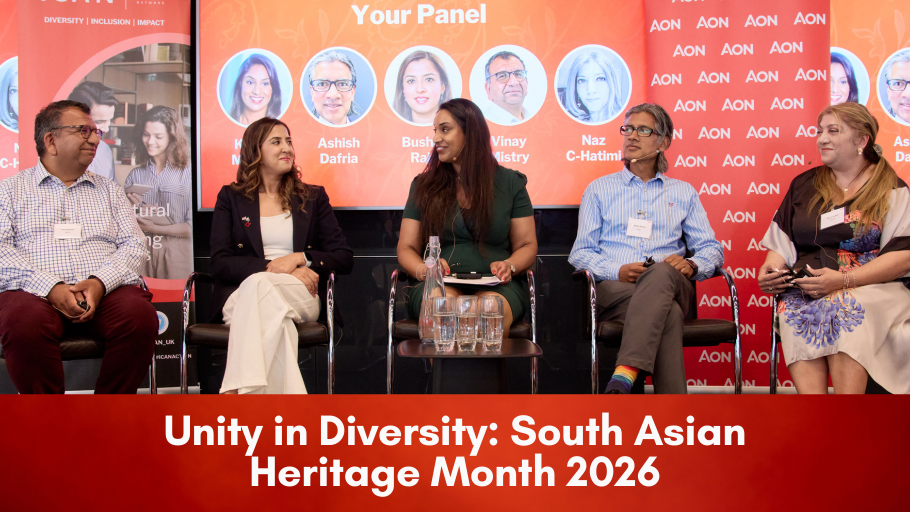
In July, iCAN and Aon brought together professionals from across the London insurance market for Unity in Diversity, an evening marking South Asian Heritage Month 2026.
Held at Aon's Leadenhall Street offices, the event combined a panel discussion with open conversation, networking and honest reflection on identity, leadership and representation in the workplace.
South Asian professionals are a significant and growing presence across insurance, yet senior representation remains disproportionately low compared with junior and mid-level numbers. That gap sat at the heart of the evening's conversation, moderated by Kishan Mangat, Co-Chair of iCAN, with panellists Ashish Dafria, Chief Investment Officer at Aviva, Bushra Raja, Head of Legal (UK) at Aon, Vinay Mistry, Chief Commercial Operations Manager at Apollo, and Nazaneen C-Hatimi Global Internal Communications Director at AXA XL sharing personal stories and practical perspectives from their own careers.
Key Takeaways
Representation lags at senior level, but the reasons are structural, not talent-related.
Bringing your whole self to work is a business advantage, not just a wellbeing nicety.
Real change needs proactive, structural action, sponsorship, wider hiring pools, small everyday shifts, not just good intentions.
Bringing your whole self to work
The evening returned repeatedly to one idea: that identity and heritage are not something to leave at the door, but a genuine source of strength in leadership and problem solving. Diverse perspectives, the panel agreed, produce better business outcomes, not just better optics.
Bushra Raja spoke candidly about how far the industry has come when it comes to speaking up about identity, from religious observance during Ramadan to raising the visibility of South Asian history within Britain more broadly.
“Ramadan / now it's a lot easier to speak up, we have moved a long way, but we can educate.” Bushra Raja, Aon
She was clear that recognition matters, pointing to the importance of the South Asian community claiming its place in history, including its involvement in the First and Second World Wars.
“It's really important the South Asian community should partake and claim what part of history with involvement in the WW1 and WW2 is.” Bushra Raja, Aon
On bias, she was equally direct: unconscious bias still outweighs conscious bias, and subtle barriers can leave people feeling they have to work twice as hard. Her message, though, was one of progress. The industry has come a long way in giving people the confidence to speak up, and that momentum needs to keep being pushed.
“There's a lot more unconscious bias than conscious; there are subtle barriers that make you feel like you have to work twice as hard, but we have come a long way, being able to speak up, and we keep pushing.” Bushra Raja, Aon
Nazaneen C-Hatimi picked up the theme of inclusion, cautioning against assuming that not everyone wants to take part in event-based initiatives, and calling instead for teams to speak out and create a genuine sense of belonging for those who do want to be involved. She also spoke warmly about the innate sense of community within South Asian culture, and the instinct to look after one another, both inside and outside the workplace.
“We have an innate sense of community - and wanting to look after each other.” Nazaneen C-Hatimi, AXA XL
Widening the talent pool
“Nothing changed if nothing changes, keep curiosity, keep developing.” Ashish Dafria, Aviva
Ashish Dafria brought energy and challenge in equal measure. His central message was simple: nothing changes if nothing changes, and staying curious and continuing to develop must be a constant discipline, not a one-off effort. He was equally forthright on recruitment, urging employers to widen their talent pools rather than relying on the same familiar routes into the industry. Narrowing the search, he argued, means missing out on an extensive pool of talented people who bring a genuinely diverse range of input to insurance.
“Make the pool wider; you're missing out on an extensive pool of really good people that will bring a diverse range of input into the insurance industry.” Ashish Dafria, Aviva
He also spoke to the strengths South Asian professionals bring to the table, describing a strong work ethic and a particular skill for working out impact and finding a way through ambiguity.
“People from South Asian heritage have strong work ethics - people from SA backgrounds love how to work out the impact, through ambiguity.” Ashish Dafria, Aviva
Respect, humility and the London Market family
Vinay Mistry offered a more personal reflection on cultural barriers, touching on humility and respect as values instilled early on, and the difference between home life and professional life. He noted that it is entirely possible to ask questions and challenge respectfully without undermining that respect and observed that the newer generation is becoming a little more outspoken, even as older, more subtle cultural patterns remain imprinted in how people think and behave.
“Home life and professional life are different; it's okay to ask questions that don't undermine respect - the new generation are a little bit more outspoken - subtle and imprinted in how people think.” Vinay Mistry, Apollo
He was equally positive about what makes the London Market distinctive. Despite the competition between businesses and individuals, he described it as operating like a family, where people grow alongside one another over time, and there is always someone to call on. That sense of community, built over years of shared experience, came through as one of the evening's warmer themes.
“Family environment - we all compete against each other, but it really operates as a family; you grow with each other through time - there's always someone that you can call, and it operates in that way.” Vinay Mistry, Apollo
Code-switching, leadership and belonging
Beyond the panel's individual reflections, the wider discussion explored how workplace culture can unintentionally exclude people, particularly where social events centre heavily around drinking. Small, practical changes such as offering non-alcoholic options, thinking about food choices and building in more flexible formats for events were raised as simple but meaningful ways to make everyone feel included.
On leadership, empathy emerged as a recurring thread, along with the idea that small, proactive actions can do more to build belonging than any formal policy. Sponsorship, rather than mentoring alone, was highlighted as one of the more powerful tools available to leaders who want to see real change in representation.
The conversation also challenged the familiar idea of hiring "the best person for the job", noting how easily that phrase can mask unconscious bias. Diversity, the panel agreed, should be treated as a genuine business advantage rather than a box-ticking PR exercise. On recruitment specifically, the call was for employers to widen their search beyond elite universities, invest more in internships, shadowing and partnerships, and give proper weight to entrepreneurial experience, sport and non-traditional career backgrounds.
Code-switching, leadership and belonging
Beyond the panel's individual reflections, the wider discussion explored how workplace culture can unintentionally exclude people, particularly where social events centre heavily around drinking. Small, practical changes such as offering non-alcoholic options, thinking about food choices and building in more flexible formats for events were raised as simple but meaningful ways to make everyone feel included.
On leadership, empathy emerged as a recurring thread, along with the idea that small, proactive actions can do more to build belonging than any formal policy. Sponsorship, rather than mentoring alone, was highlighted as one of the more powerful tools available to leaders who want to see real change in representation.
The conversation also challenged the familiar idea of hiring "the best person for the job", noting how easily that phrase can mask unconscious bias. Diversity, the panel agreed, should be treated as a genuine business advantage rather than a box-ticking PR exercise. On recruitment specifically, the call was for employers to widen their search beyond elite universities, invest more in internships, shadowing and partnerships, and give proper weight to entrepreneurial experience, sport and non-traditional career backgrounds.
Thank you
Unity in Diversity was an evening defined by honesty as much as celebration. Strong work ethic, community-mindedness, adaptability through ambiguity, ambition, relationship building and perseverance came through repeatedly as strengths that South Asian professionals bring to the insurance industry. As Ashish Dafria put it, nothing changes if nothing changes. The evening was a reminder that progress depends on continued curiosity, continued conversation and continued action, not just from South Asian professionals themselves, but from the industry.
Thank you to Aon for hosting, and to Ashish, Bushra, Vinay and Nazaneen for speaking so openly.
About iCAN
The Insurance Cultural Awareness Network (iCAN) is a leading organisation committed to promoting diversity and inclusion in the insurance sector. Established in 2017, iCAN has been instrumental in spotlighting cultural awareness, fostering talent, and championing diversity within the industry.