Faith, Sacrifice and Community: iCAN's Eid al-Adha Celebration
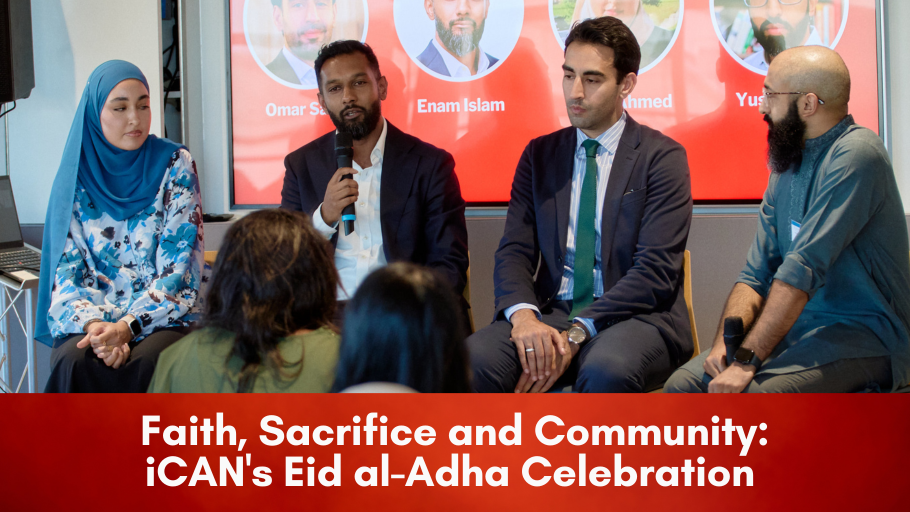
On Thursday 2 July, iCAN brought together colleagues from across the insurance market for an evening celebrating Eid al-Adha, hosted in partnership with Clyde & Co, QBE, Canopius and Chaucer.
As millions of Muslims around the world completed the Umrah pilgrimage in Mecca, the event created space for the industry to explore what Eid al-Adha means, in the words of those who observe it.
Guests were welcomed with traditional halal food in a market-style setting before moving into a panel discussion chaired by Yusouf Kaj, Diversity & Inclusion Manager at Clyde & Co. Joining him were Omar Salha, Founder of The Ramadan Tent Project, Enam Islam, Exposure & Pricing Senior BA at Sirius Point, and Sarah Ahmed, Business Analyst at Markel. Together they explored themes of sacrifice, identity, generosity and what it means to carry faith and tradition into a modern, multicultural workplace.
Key Takeaways
Sacrifice is a shared language across faiths, not just an Islamic one. From Ramadan and Hajj to Yom Kippur's 25-hour fast and the 40 days of Lent, the panel highlighted a common pattern running through Islam, Judaism and Christianity. The panel recognised that sacrifice also extends beyond faith, reflecting a universal human value, whether in time given to family, effort put into charitable work, or simply putting others first for the greater good; something people from all backgrounds can relate to and learn from.
The next generation is holding onto faith differently, not less. Younger Muslims are using social media to learn, connect and support one another, and are more willing than earlier generations to hold to their beliefs openly and visibly, without the fear of standing out that shaped their parents' or grandparents' experience.
Everyday workplace curiosity is part of inclusion, not a barrier to it. Colleagues asking honest questions about dress, practice or why Eid falls on a different day each year isn't something to shy away from. The panel framed this openness and the willingness to explain and be asked as exactly what makes a pluralistic workplace feel genuinely inclusive.
The personal meaning of Eid
For Sarah, Eid carries a weight that goes well beyond a single day off work. Reflecting on her own first experience of Hajj, she described the pull of standing shoulder to shoulder with people from every background, all doing the same thing, yet each having a completely different internal experience.
"Everyone is going through their own spiritual battles," she explained. "It's a time for reflecting on yourself and your actions and your everyday behaviour." She spoke candidly about the sacrifices women in particular make in their lives and how moments like Hajj offer something rare: permission to put yourself and your faith first.
Sacrifice as a shared thread across faiths
Omar picked up the theme of sacrifice and broadened it, drawing comparisons across Islam, Judaism and Christianity. He pointed to Yom Kippur's 25-hour fast as, in his view, even more demanding in some respects than Ramadan, and to Lent's 40 days of giving something up, as evidence of a pattern that runs through all three major faiths.
"Look outside those spaces, and there's a running pattern," he said. "What we're ultimately saying is: be good to those who are less fortunate, be good to your neighbours, be kind." For Omar, this was the universal thread that unites people of different backgrounds far more than any surface-level difference divides them.
He also reflected on how visible Muslim identity has become in everyday British life, from the language people use to the curiosity colleagues show about dress and practices. "It's about being able to be your authentic self and genuine with one another," he said, describing life in a pluralistic society as an ongoing act of realignment and renewal, much like the festivals themselves.
Passing tradition to the next generation
Enam brought a parent's perspective to the discussion, reflecting on the importance of helping younger generations understand not only what religious acts involve, but also the deeper meaning and teachings behind them. Conversations with his nine-year-old son often include explaining why Eid does not follow the fixed dates of the Western (Gregorian) calendar but instead is determined by the Islamic lunar calendar. This has prompted discussions about the significance of the new moon sighting, why religious observances can vary by a day between different countries or communities, and how the lunar cycle has shaped Islamic traditions and practices for centuries.
While translating beliefs and experiences built over a lifetime into terms a child can understand can be challenging, Enam has been encouraged by his son's curiosity and willingness to ask thoughtful questions. These conversations often move beyond explaining traditions to exploring the lessons and values behind them, such as faith, sacrifice, gratitude, and community, and how they can be applied in everyday life. They also provide an opportunity to hear how younger generations interpret these teachings and what relevance they see them having in their own lives.
The discussion highlighted how younger generations may not always fully appreciate the sacrifices made by previous generations, yet they often engage with faith in a different way, asking thoughtful questions, seeking a deeper understanding of the meaning behind religious practices, and exploring how those teachings connect to the world around them.
Social media, identity and staying true to belief
Discussion turned to how younger generations navigate faith in a hyper-connected world. The panel agreed that social media has become a genuinely useful tool for education and connection, helping Muslims learn from one another's traditions across countries and cultures, and helping the wider community rally around shared causes.
But it comes with trade-offs. The panel noted that younger people are, in many ways, more confident than earlier generations at holding to their beliefs openly. Where first-generation migrants often felt pressure not to stand out, today's generation is more willing to make visible choices, including stepping back from brands or causes that sit uneasily with their values, without fear of the consequences.
A shared narrative, however, it is observed
Throughout the conversation, one message came through clearly: however, Eid al-Adha is marked, whatever traditions differ from household to household or community to community, the underlying values of generosity, humility and connection to others are shared far more widely than they differ. As Omar put it, "there's so much more shared than there is different."
For an industry increasingly focused on inclusion, events like this one offer something simple yet valuable: a chance to sit with colleagues, ask honest questions, and hear directly from those who observe traditions that shape their everyday lives.
Thank you
iCAN would like to thank Clyde & Co, QBE, Canopius and Chaucer for their partnership in bringing this event to life, and to Omar Salha, Enam Islam, Sarah Ahmed and Yusouf Kaj for such an open and candid discussion.
About iCAN
The Insurance Cultural Awareness Network (iCAN) is a leading organisation committed to promoting diversity and inclusion in the insurance sector. Established in 2017, iCAN has been instrumental in spotlighting cultural awareness, fostering talent, and championing diversity within the industry.